
Australia is known for its collection of peculiar animals. Monotremes may be the most fascinating of all. Being the only mammals that lay eggs, they captivate our interest and curiosity. The platypus and echidna make up this group of animals. While they have some things in common, they also have many differences.
The Platypus

Appearance
The platypus is a short, streamlined animal growing to around 50 centimetres in length. Thick brown fur covers their body, keeping them dry even when underwater.
Large, webbed feet and claws help them easily move through the water and dig burrows. One of the most interesting features of the platypus is their bills, which are equipped with electroreceptors that help them locate their food.
While swimming, they are temporarily blind because skin flaps cover their eyes and ears underwater.
Mature male platypuses grow poisonous spurs on their rear legs, which they use to defend themselves against other males during fights.
Diet
Platypus feed on small fish, yabbies and other small creatures like worms.
They have a big appetite, consuming between 20% to 50% of their body weight in food daily. To put that into perspective, a 60 kilogram human would need to eat at least 12 kilograms of food a day!
Without any teeth, they grind up their food with hard plates on their jaws.
Habitat
The platypus inhabits freshwater systems along Australia’s eastern coast. A platypus will dig simple burrows along rivers and streams, where they can stay safe. They prefer shallow areas as they search for food on the riverbed.
These elusive creatures are usually shy, making dawn or dusk the best time to spot them. While they can stay in the water for long periods, they can only stay underwater for short stints of up to 2 minutes.
Lifecycle
A pregnant platypus will dig burrow chambers into riverbanks to lay 1 to 3 eggs. After approximately ten days, the hairless babies hatch and suckle from their mother for 3 to 4 months.
The mother has special patches of skin on the abdomen that secrete milk for her young instead of teats.
Platypuses can live for a long time, surviving for over 20 years in captivity and up to 12 years in their natural habitat.
Echidna

Appearance
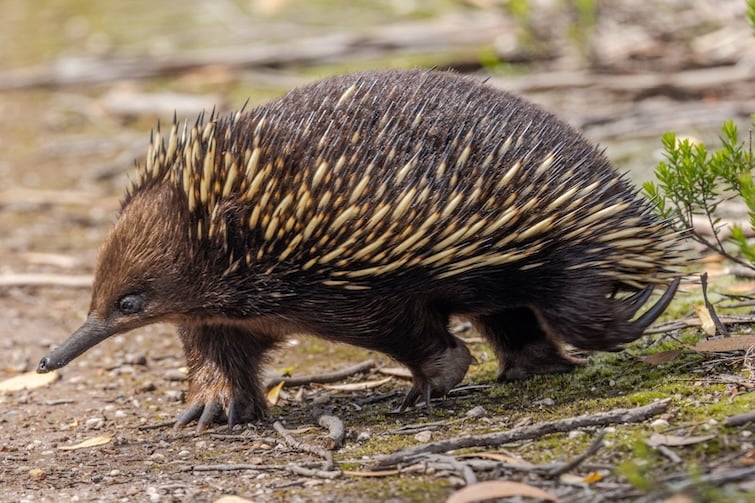
The echidna is a fascinating creature with a distinctive appearance. Its stout, compact body, elongated snout, and small head make it easily recognisable.
The echidna’s spines, which can grow up to 5 centimetres long and are brownish-black, are a distinctive feature which provides excellent protection against predators. The echidna also has soft fur covering its body.
Echidnas have a tube-like snout with a toothless mouth at the end. With its long tongue (around 17 centimetres) covered in sticky saliva, the echidna can easily slurp ants and other insects.
Short and stubby, the legs of an echidna have claws on the front feet that can break open logs and termite mounds and dig burrows. The echidna’s hind feet face backward, allowing it to push the soil away when digging.
Diet
Echidnas have the remarkable skill of flicking their tongues in and out up to 100 times per minute, allowing them to consume ants and termites easily.
The short-beaked echidna feeds in the early morning and late evening, relying on its highly developed sense of smell to locate its next meal.
Habitat
The short-beaked echidna is a remarkable animal found in Australia. It can adapt to various conditions, including snowy environments and arid deserts. Other species of echidna are found in New Guinea.
Lifecycle
Echidnas lay one soft-shelled egg at a time. The egg is placed in the mother’s backward-facing pouch and hatches after ten days.
A hairless and blind baby echidna, known as a ‘puggle,’ is approximately the size of a jellybean.
Echidnas do not have nipples, so the puggle suckles from specialised pores while carried in the mother’s pouch for three months. Once their tiny spines sprout, the puggle will leave the pouch and eventually wean entirely at around 12 months.
The echidna’s lifespan ranges from 15 – 40 years but typically averages around 10 years in the wild.
Where Can You Find Monotremes Around Brisbane – In the Wild
Both echidnas and platypus are wild animals in Australia, and as such, can be found in the wild, including in and around Brisbane.
Platypus, are rather shy, making them difficult to spy in the wild, but if you are very quiet, and visit early in the morning or late afternoon, then you may just be lucky enough to spot one.
Some places they have reportedly been spotted include:
- South Pine River, near Eatons Hill or Albany Creek
- Moggill Creek
- Obi Obi Creek, Maleny
Obi Obi Creek in Maleny is one of the most popular places to spot platypus. A flat boardwalk, affectionately known as Platypus Walk, hugs Obi Obi Creek and has several viewing platforms, making it the perfect way to enjoy a stroll in nature and perhaps spot one of these magnificent monotremes in the wild.
Echidnas on the other hand are a little harder to pinpoint. Just keep your eyes open as you are going about your business, particularly early morning or late afternoons.
Insiders Tip: If you want to see a big platypus sculpture, and have fun at an awesome fully, fenced playground, visit CREEC in Burpengary.

Where Can You Find Monotremes Around Brisbane – Zoos and Sanctuaries
If you want to be guaranteed an echidna or platypus sighting (well they may be hiding out of sight even in an enclosure), head to one of the following venues:
- Lone Pine Koala Sanctuary (platypus and echidna)
- David Fleay Wildlife Park (platypus)
- Currumbin Wildlife Sanctuary (echidna)
- Wildlife HQ (echidna)
- Australia Zoo (echidna)
The monotremes of Australia are an oddity of nature, mammals which lay eggs and nurse their young. Yet, it is their unusual features that make them so fascinating. Neither of these animals are currently considered endangered, meaning magnificent monotremes will continue to be an important part of Australia’s unique animal life.


Join the conversation