
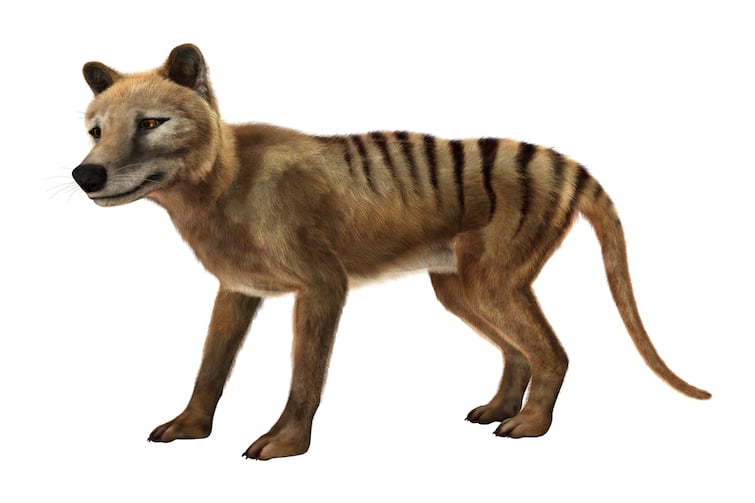
Have you heard of the Tasmanian tiger, also known as the thylacine or Tasmanian wolf? It was a large, carnivorous marsupial, looking like a cross between a dog, tiger and wolf. This fascinating creature had stripes on its back, a long stiff tail and short erect ears, which is how it got its name – Tasmania tiger!
Whatever you do, don’t confuse the Tasmanian tiger with the Tasmanian devil! Unfortunately, the Tasmanian tiger is now considered extinct, while the Tassie devil is well and truly alive and can still be seen throughout Tasmania and in zoos around Australia.
Fun facts about Tasmania tigers
- The Tasmanian tiger had dark stripes across its back, from the base of its tail to its shoulders.
- It had large, powerful jaws which contained 46 teeth.
- Despite its name, the Tasmanian tiger was shy and would avoid contact with humans
- The Tasmanian tiger didn’t make a lot of noise but would bark (sounding a bit like a husky cough) when they were excited or anxious.
- They would make a yapping sound when hunting, a bit like a small dog.
- A baby Tasmanian tiger is called a joey
- Female thylacines would give birth to a litter of between 2 – 4 joeys
- The young joeys would be dependent on their mother, living in her back-facing pouch, until they were half-grown.
- The life expectancy of a Tasmanian tiger in the wild was thought to be about five to seven years.
- The last known Thylacine in captivity was called ‘Benjamin.’ He died at a private zoo in Hobart in 1936.
- Although there are still reports of Tasmanian tiger sightings, no sighting has ever been confirmed.
- The Tasmanian tiger species was officially declared extinct in 1986.
- The Tasmanian tiger features on both the Tasmanian Coat of Arms and the Tasmanian Government logo.
What did a Tasmanian tiger look like?
A Tasmanian tiger looked a little bit like a dog, with relatively short legs, a large head and a long, stiff tail. To eat their prey, they had large, powerful jaws, with a 90-degree gape, and 46 teeth. They were covered in short fur which was usually a yellowish – brown colour, with dark brown-black stripes on its back, from the base of its tail to the shoulders.
In order to carry the young, a female thylacine had a back-opening pouch, while the males had a partial pouch, which was also back-facing. Having a pouch that opens at the back of the thylacines body means it is less likely to fill with dirt when they are moving about or scratching in the dirt.
After being pregnant for just one month, the mother thylacine would give birth to a litter (usually 2-4). These young would then make their way to their mother’s pouch and latch onto one of her four teats, where they would remain for the next 3-4 months while they were growing.
Like many species, the male thylacine was usually larger than the female, with most Tasmanian tigers weighing between 15 -30kg.
Tasmanian tiger diet
The thylacine was semi-nocturnal animal. Occasionally it ventured out during the day, but mainly choose to hunt for food at night, either by themselves or in pairs, using its keen sense of smell and stamina to be successful in catching prey.
As they were carnivorous, their preferred diet was that of kangaroos, wallabies, birds, small rodents and other marsupials.
Tasmanian tiger habitat
Although it is called the Tasmanian tiger, the thylacine could actually be found throughout Australia, and even in parts of New Guinea. However, before its extinction, it was solely found in Tasmania.
The preferred habitat of the thylacine was the dry eucalypt forests, grasslands and even wetlands.
The Last Tasmanian tiger
It was reported there were once more than 5,000 thylacines roaming throughout Tasmania, though due to hunting, introduced disease and habitat destruction, the numbers soon reduced rapidly.
Fearing extinction, the Tasmanian tiger was added to the protected wildlife list, however it was sadly too late. ‘Benjamin’ the last know thylacine, died in captivity at a Hobart Zoo on the 7th of September, 1936.
Tasmanian tiger sightings
Despite officially declared extinct in 1986, people still claim to have spotted the Tasmanian tiger in the wild. Unfortunately, each supposed sighting was ruled inconclusive, and the species remains extinct.


Join the conversation